
Global Access to Wealth Creation and Inclusion is Here and It’s Built on Solana.
Enter the Beehive
Article Highlights: TL;DR
- The Legacy Wall (1975–Present): Traditional finance relies on an "Indirect Holding System" where retail investors own "security entitlements" rather than the assets themselves, a structure that excludes roughly 75% of the global population.
- Solana as the Shared State Machine: Solana provides the foundational layer for Internet Capital Markets (ICM), enabling atomic settlement, low costs (~$0.001), and high throughput to replace siloed legacy databases.
- Technological Leapfrogging: Much like mobile money, emerging markets are skipping outdated Western brokerage models to connect directly to global capital through software.
- Nectarfi as the Global Terminal: Acting as a self-custodial gateway, Nectarfi provides African investors with direct access to global equities and stablecoins without the friction of traditional intermediaries.
- Interoperable Exit Rails: The integration of shared redemption mechanisms (pioneered by Sunrise DeFi and Backpack) ensures users maintain true ownership and can redeem assets across different platforms, avoiding vendor lock-in.
- Proof of Concept: The tokenized SpaceX (rSpaceX) offering demonstrated how fractionalized assets with $50 minimums can democratize elite wealth creation for anyone with an internet connection.
For decades, investing in Africa across borders meant trusting a chain of proxies. For a practical example, if an investor in Lagos or Nairobi wanted a stake in global growth, they faced a wall of offshore brokerages, wire fees, and strict geographical limits. Additionally, trading meant waiting days – historically a T+2 settlement cycle – while a network of hidden intermediaries manually matched balance sheets across different continents. The reality of this proxy is that traders do not own the asset; instead, they own a promise from someone who did.
That very setup is hitting a technical dead end.
Today, a user in Nigeria can open an app, fund it through a local bank transfer, and buy a fractional stake in global companies like SpaceX, etc in a matter of minutes. This is a structural bypass, and it introduces something cleaner: direct ownership.
True financial inclusion isn't about distributing local currency aid; it is about providing unmediated access to global capital.
The internet gave us a shared machine for information. Now, Solana operates as a shared state machine for value – the underlying infrastructure for Internet Capital Markets (ICM). So If Solana is the world’s open stock exchange, Nectarfi is the global terminal connecting the African continent directly to it.
How did we arrive at the Legacy Wall (1975–2024)?
The exclusion of the global retail public from top-tier wealth creation was not an historical accident. It was a workaround for a plumbing problem encoded into law half a century ago.
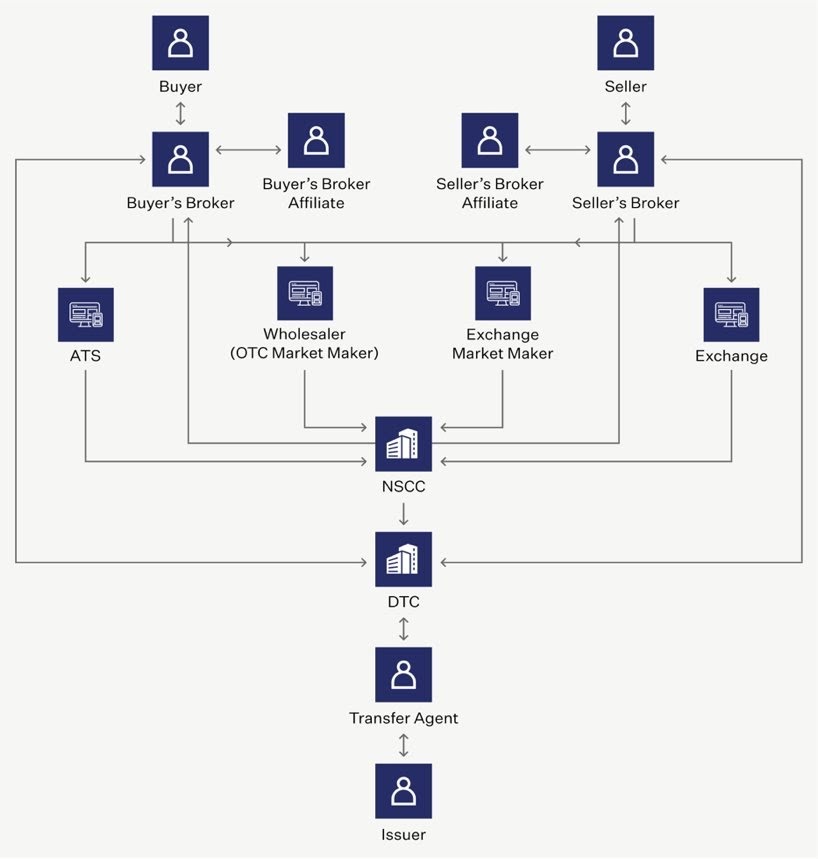
During the "Paperwork Crisis" of the late 1960s, Wall Street nearly choked on its own success. The volume of physical, hand-delivered stock certificates overwhelmed brokerages, forcing the markets to shut down early on Wednesdays just to process the backlog. To fix this, the 1975 Securities Act Amendments "immobilized" paper certificates. They were locked in a central vault managed by the Depository Trust Company (DTC/DTCC).
This birthed the Indirect Holding System. Real ownership stayed with the central depository. Retail investors were handed "security entitlements" – a legal layer of insulation between the saver and the company. This structure built a legacy wall. While it kept Wall Street from drowning in paper, it created a massive access gap, keeping roughly 75% of the planet outside the system.
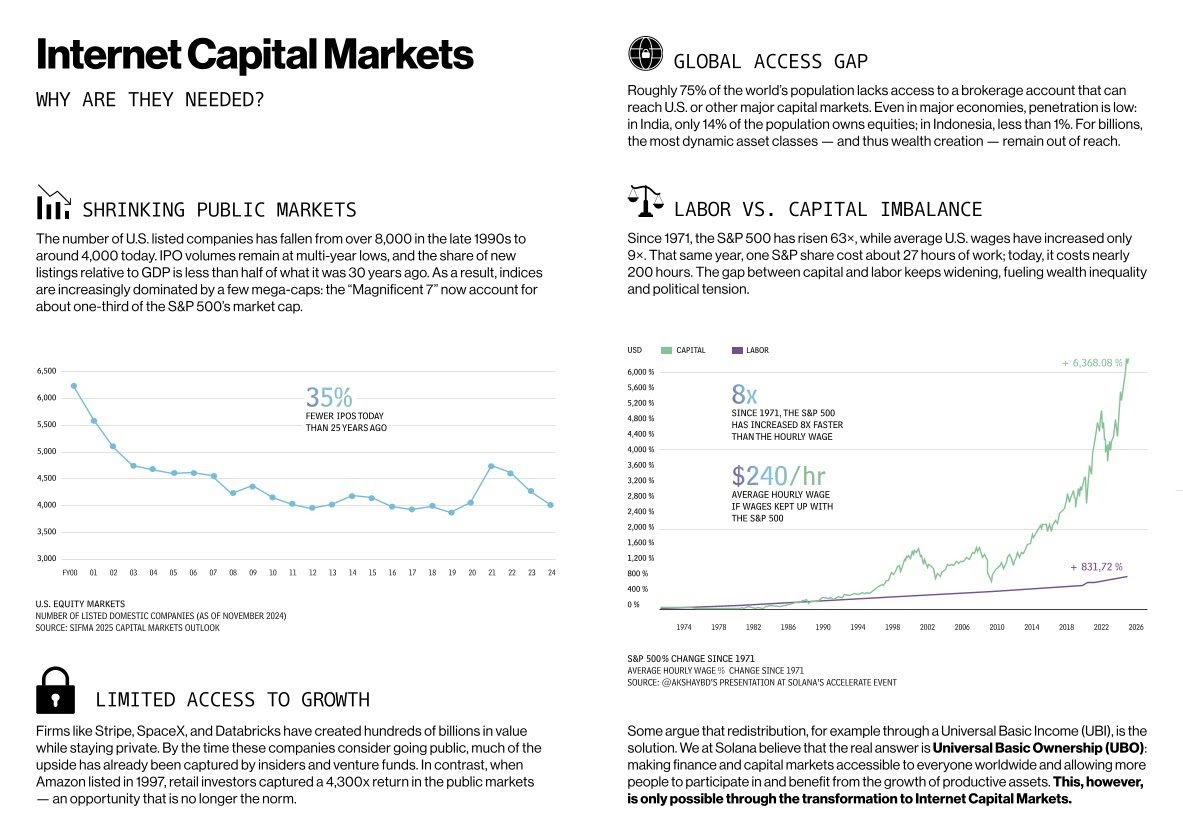
The cost of this insulation has been severe. Since 1971, the S&P 500 has grown over 60-fold, while average consumer wages grew less than 10-fold. For billions of people across Africa, building wealth within local, inflation-heavy fiat currencies has been like running on a treadmill. Wealth accumulated in global equities on the other side of the wall, accessible only to those with the right passport or institutional scale.
 Introducing the Internet Capital Markets (ICM) – The Modern Paradigm
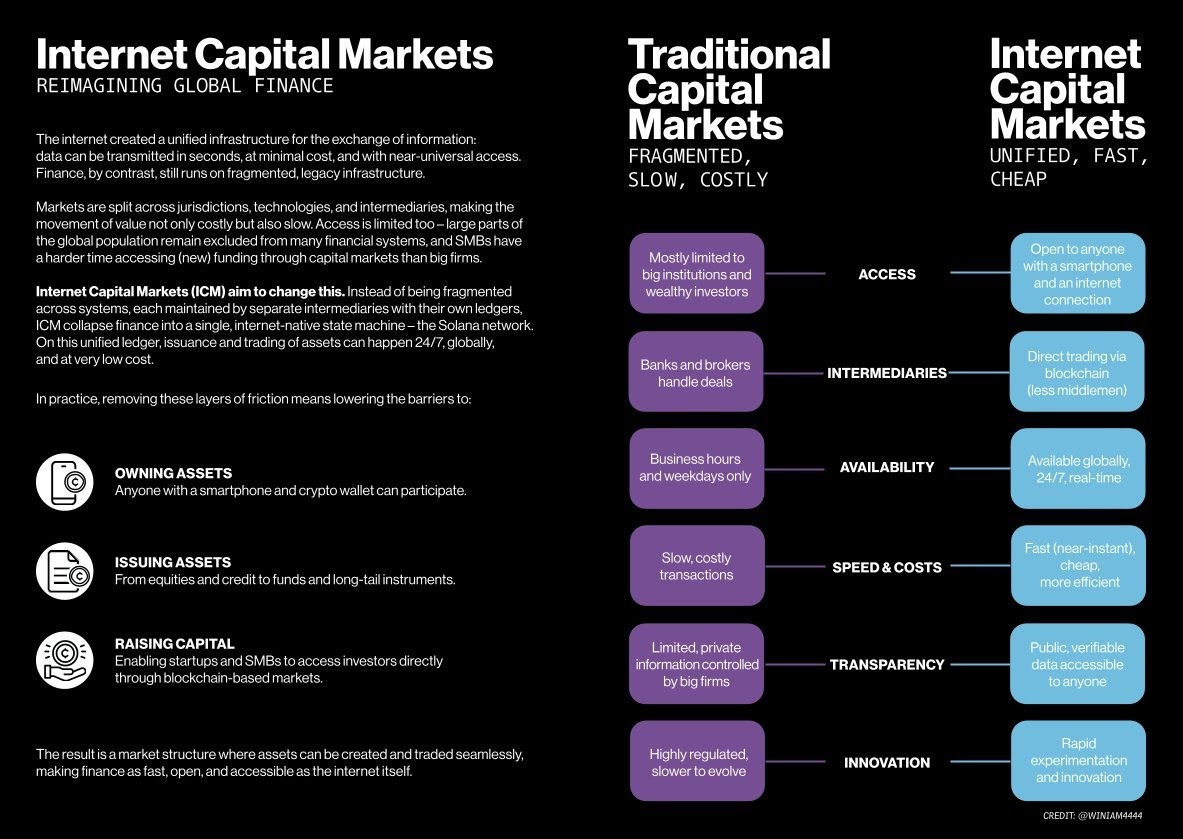
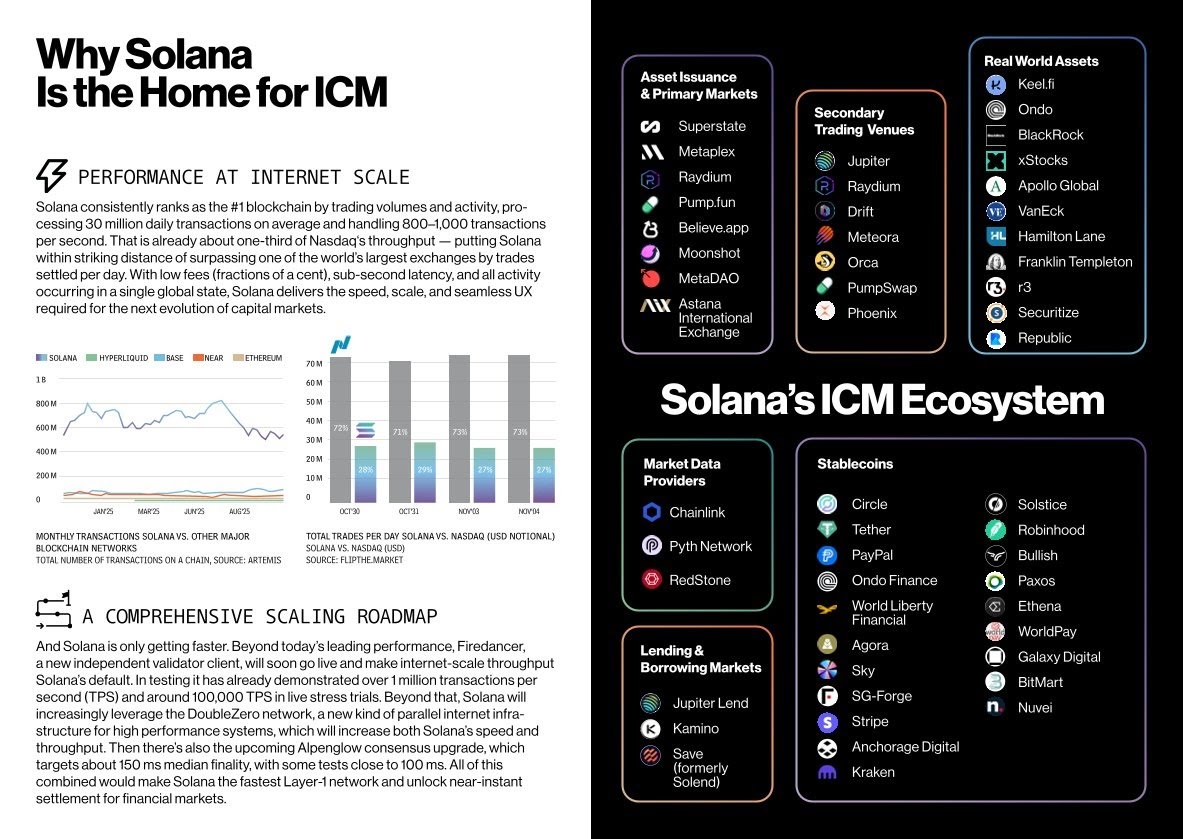
Internet Capital Markets (ICM) collapses this multi-layered architecture. ICM is the transition of global finance from siloed databases to an open, shared ledger in which capital formation, trading, and settlement occur simultaneously. In this paradigm, code handles what clearinghouses used to guarantee, stripping away structural rent-seeking and artificial boundaries.
 Solana’s 2025 Internet Capital Markets Report, Superteam Germany.
To serve as a global financial engine, a blockchain cannot rely on sluggish or fragmented networks. It needs execution that matches the speed of commerce. So Blockchain like Solana achieves this not by adding complex layers, but through a fast, single-layer design:
Atomic Settlement: Execution and settlement happen in the exact same ledger update. This eliminates counterparty risk – the danger that one side fails to deliver after a trade is agreed.
Low Costs: Transaction costs drop to fractions of a cent (~$0.001), turning micro-investments from a loss-leader into a viable practice.
Throughput: Processing tens of millions of transactions daily with sub-second finality, matching the performance requirements of modern electronic exchanges while remaining publicly auditable.
The Missing Link: Technological Leapfrogging
 To fully understand why this model fits the African continent, we must look at how emerging markets adopt technology.
Developing economies rarely catch up by building exact copies of old Western infrastructure. Instead, they skip generations entirely – a process known as technological leapfrogging.
Africa famously skipped the era of copper telephone wires, moving straight to cellular networks. It bypassed physical credit card networks to pioneer mobile money (like M-Pesa). The same shift is happening in wealth creation. African savers do not need to build regional clearinghouses or complex domestic brokerage networks modeled on 1970s Wall Street rules. They can leapfrog the legacy wall entirely, using software to connect directly to the global pool of value.
Nectarfi as the Global Terminal
 If Solana is the bare metal infrastructure, Nectarfi is the terminal that makes it usable. Historically, crypto has suffered from fragmentation. That's, a user often needed separate applications to protect savings from inflation, swap tokens, manage private keys, and find yield. Nectarfi consolidates these functions into one entry point.
As a self-custodial gateway, Nectarfi connects local banking systems to global financial markets without taking custody of user funds. Its architecture focuses on removing friction:
Simple Onboarding: It uses secure, embedded wallets powered by Privy, allowing users to log in via standard web credentials while retaining ownership of their keys.
Integrated Rails: It bridges local payment systems – like bank transfers in Nigeria or global settlement networks – directly into stablecoin and equity layers.
Asset Access: It taps into platforms like Xstocks for U.S. equities and Kamino for liquidity, allowing users to move capital fluidly between savings and investments.
Nectarfi is rethinking credit assessment. Traditional models like the FICO score are backward-looking and heavily dependent on debt accumulation within traditional banking. Nectarfi introduces an on-chain Trust Score. By tracking transaction consistency, savings behavior, and on-chain history, it builds an equitable profile for users who operate outside the legacy banking system.
Interoperable Exit Rails
Crucially, the ICM paradigm avoids the "vendor lock-in" of traditional finance. By utilizing shared redemption mechanisms – such as those developed by Sunrise DeFi and Backpack – the ecosystem ensures that users are not dependent on a single gateway to access their capital. If a user acquires an asset through Nectarfi, they are not "locked in" to that terminal; the asset remains redeemable across the broader Solana shared state machine.
This creates a "global exit" for capital, ensuring that the "Atomic Settlement" promised by the ledger is backed by universal, cross-platform liquidity.
Case Study – The SpaceX Offering
The practical value of this stack was demonstrated during the recently tokenized offering of SpaceX equity via Republic’s Mirror Tokens (rSpaceX).
Late-stage private companies are usually elite clubs. Exposure is usually restricted to venture funds and accredited individuals who can meet multi-million-dollar minimum allocations.
The rSpaceX drop altered this mechanic. By utilizing a regulated tokenized structure on Solana, the asset was split into fractional shares with a minimum entry point of $50.
For a retail investor in an emerging market, this changed everything. They didn't have to wait for a traditional IPO or seek permission from local financial institutions, as the software allowed them to purchase, hold, or send fractional exposure across the internet in minutes.
This proved the core premise of Internet Capital Markets: when you remove the friction of the legacy holding system, you democratize premium global growth assets for anyone with an internet connection.
Conclusion: The Beehive Effect
The internet has spent its first few decades decentralizing media, information, and communication. Through Solana and Nectarfi, it is now shifting the plumbing of property and wealth.
This ecosystem functions like a beehive: a coordinated network of builders, capital pools, and individual users operating on a shared infrastructure.
While the old financial system relied on geography and administrative friction to maintain its borders, the Internet Capital Markets is making those boundaries obsolete. Investors are no longer waiting for legacy systems to upgrade their networks because the market has transitioned to the internet, and the terminal is live.