
Prediction Market in Africa: Is Africa's Betting Habit Going Onchain?
Africa has 440 million active bettors and $3.6B in sports betting volume—and a quiet cohort of builders is now repurposing that same infrastructure for blockchain-based prediction markets. No house edge. No bookmaker. Just you, your wallet, and the market.
TL;DR
Africa operates the globe's most mobile-centric betting market—440 million active bettors, $3.6B in Nigerian sports betting alone, with 91% of wagers placed via smartphones. The same technological infrastructure is being repurposed for blockchain-based prediction markets.
Within the last 60 days, three simultaneous, independent developments converged: SuperteamNG's builder cohort began releasing consumer prediction-market applications (Hottake, Bayse, Headlineodds). Luno launched 24-hour crypto prediction markets in Nigeria and South Africa, powered by Limitless infrastructure and settled in USDC. Bayse Markets—currently listed by Lagos State as an illegal gaming operator—launched USD/NGN currency markets enabling Nigerians to take foreign exchange positions in naira with a ₦500 minimum, settled against CBN and FMDQ data.
The mechanism differs fundamentally from sports betting. There exists no bookmaker, no house edge, no overround. Prediction markets function as peer-to-peer binary contracts on verifiable outcomes—resembling derivatives more closely than traditional sportsbooks. Yet user behavior remains identical, creating psychological frictionless adoption. The same bettor who stakes ₦500 on Chelsea remains one wallet away from staking ₦500 on a central bank rate decision.
This doesn't represent Web3 rescuing anyone from gambling, nor prediction markets displacing sports betting. Rather, it constitutes an expansion of the user's risk exposure—identical impulses directed toward a vastly broader universe of priceable events.
The primary constraint isn't user adoption. It's regulatory clarity. Every prediction market across the continent operates within a gap between gaming law and securities law. Whichever regulator moves first—likely FSCA South Africa or SEC Nigeria—will establish the precedent remaining jurisdictions adopt.
gm boothies.
 Today is for the Afro degens.
Who has the Alpha odds?
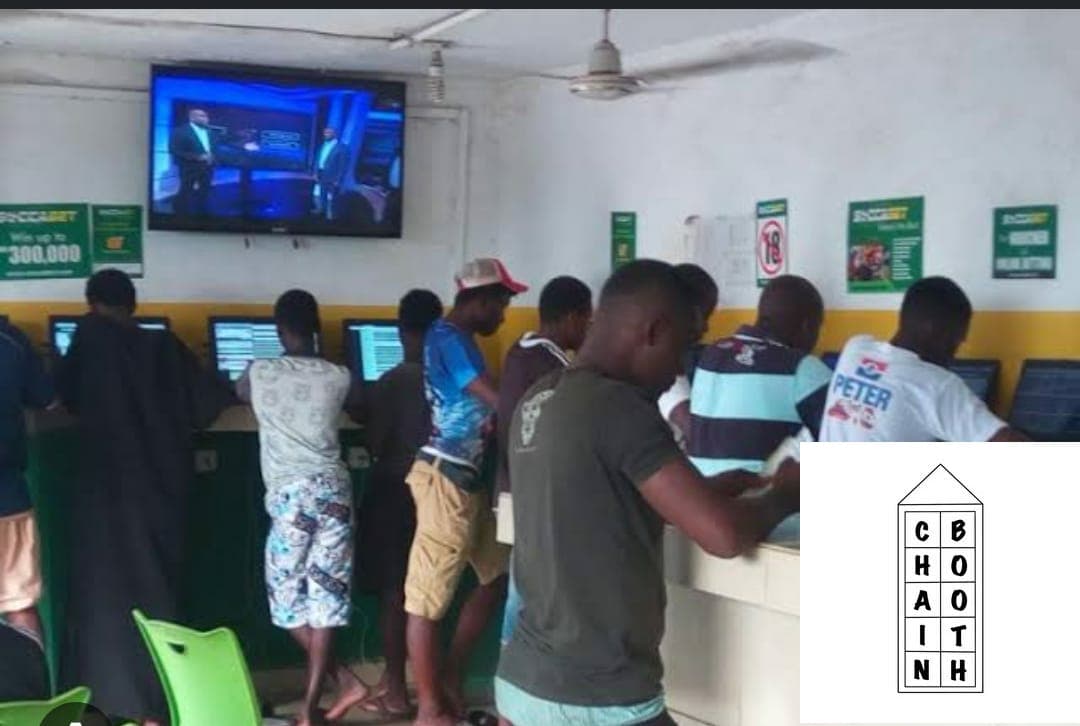
If you have walked down a single street in Lagos, Nairobi, Joburg, Accra, or Kampala this year, you’ve witnessed the visual architecture of African risk. It is everywhere. The tightly folded thermal paper trailing out of a sports betting terminal in stable micro-neighborhoods; it’s the frantic screenshots of a 15-leg SportPesa multibet plastered on WhatsApp statuses; it’s the crinkled Hollywoodbets stub gripped tightly in a passenger’s hand inside a Cape Town taxi.
We have managed to craft out a vibrant, high-volume ecosystem on X and Telegram dedicated entirely to selling, analyzing, and debating odds. This is not an exaggeration; it is our economic reality. The macroeconomic backdrop across the continent has turned speculative risk into a structured survival mechanism..
The data is staggeringly evident:
- 440 million active bettors across the continent.
- Nigeria alone anchored an estimated $3.6 billion sports betting market in 2025.
- South Africa books over R5.5 billion in Gross Gambling Revenue (GGR) from sports betting alone.
- Kenya’s adult gambling participation rate sits at an astonishing 83.9%.
- Crucially, 91% of those wagers are placed entirely via mobile devices.
This is the most culturally accepted, deeply regulated, and mobile-native form of mass financial speculation on the continent. And right now, a quiet, uncoordinated cohort of builders on Solana, Base, and Limitless is running straight into the back of it.
The bet slip is advancing onchain. It's the identical punter, using a brand-new rail.
What Changed in the Last 60 Days?
Three independent, uncoordinated developments just collided, pointing directly toward the exact same tectonic shift.
1. The SuperteamNG Pipeline Starts Mass-Shipping
 The local developer ecosystem has stopped building abstract protocols and begun shipping consumer-facing prediction infrastructure.
- Hottake—described by its creators as “a pocket-sized prediction market where you can trade the timeline as fast as you scroll”—launched its live beta in April 2026.
- Bayse Markets (formerly Gowagr) executed a highly targeted video bounty through SuperteamNG titled “Bayse Markets × Solana: The Future of Prediction Markets,” shipping hyper-liquid 15-minute and hourly execution markets back in March.
- Headlineodds—another native prediction-market builder born out of the same community—just secured a spot in BagsApp’s massive $4M global hackathon.
This isn’t an isolated app trend. This is a deliberate category choice by Africa’s most active builder community.
2. The Institutional Play: Luno Enters the Arena
On March 19, 2026, retail heavy-hitter Luno quietly rolled out prediction markets tailored specifically for Nigerian and South African users. Powered by US-based infrastructure provider Limitless, the product is strictly crypto-native. Users leverage Bitcoin, Ether, Solana, Dogecoin, and XRP to take positions on short-term price directions, enjoying 24-hour settlements paid out directly in USDC.
Luno’s Nigeria CEO, Ayotunde Alabi, strategically framed the launch as the absolute foundation of their broader derivatives strategy. Read between the lines: the onboarding ramp to sophisticated digital derivatives isn’t a complex options chain—it’s a clean prediction market.
3. The Regulatory Defiance: Bayse Markets vs. The State
 The friction is already real. The Lagos State Lotteries and Gaming Authority (LSLGA) formally blacklisted Bayse Markets, listing them among illegal, unlicensed gaming operators. Bayse didn’t blink. Instead, in April 2026, they went live with localized USD/NGN, GBP/USD, and EUR/USD currency prediction markets.
This effectively allows everyday Nigerians to hedge against or speculate on foreign exchange volatility without a legacy forex broker, without dangerous leverage, natively in Naira, and with a micro-stake minimum of just ₦500. The settlement data is completely transparent, resolving directly against official Central Bank of Nigeria (CBN) and FMDQ data.
Bayse boldly markets itself as “Africa’s largest prediction market.” The state regulator calls them an illegal gaming house. In the current grey-market reality of African Web3, both statements are functionally true.
This is the exact texture of the migration: builders are aggressively shipping, exchanges are capturing retail volume, and regulators are struggling to define the ground they are standing on..
Why Prediction Markets? Why Now? Why Here?
To accurately map where this goes, we must strip away the noise and understand exactly what a prediction market is… and what it isn’t.
At its core, a prediction market is a binary contract tied directly to a verifiable, real-world outcome. It simplifies complex macro events into a straightforward trade:
-
Will USD/NGN close above ₦1,600 by Friday? Yes or No.
-
Will Arsenal win the Premier League? Yes or No.
-
Will Bitcoin breach $150,000 this quarter? Yes or No.
You buy a YES share at whatever price the order book dictates. If the event materializes, your contract settles at a clean $1.00 value. If it fails, it expires worthless at zero. The real-time price of the contract is simply the crowd’s financial consensus of probability. If a contract trades at 80 kobo or 0.80 USDC, the market is asserting an 80% statistical probability that the event will happen.
The Core Paradigm Shift
This is fundamentally distinct from traditional sports betting. In a standard sportsbook, a centralized bookmaker calculates fixed odds with a heavy, built-in structural margin—known as the vig or overround—forcing you to play a mathematically losing game against the house.
An onchain prediction market completely eliminates the house. It is entirely peer-to-peer (P2P). You are trading dynamic market shares directly against another human being on the other side of the continent who holds the opposite conviction.
As Bayse’s core pitch neatly summarizes:
“No bookmaker margin. No house edge. Just you, your information, and the market.”
While the internal settlement mechanism mimics a financial derivative, the user behavior—interpreting an event, choosing an outcome, staking collateral, and awaiting expiry—is psychologically identical to the sports betting habits already hardwired into the African consumer. The mental leap from placing a ₦500 bet on a football match to staking a ₦500 position on a central bank interest rate decision is entirely frictionless. The user is already pre-trained; they just need a Web3 wallet.
The Macro Triggers
-
Why Now? The global proofs-of-concept have reached escape velocity. Kalshi cleared an astronomical $7.5 billion in volume in under 15 months, while Polymarket secured high-profile Series A backing and mainstream cultural status. The category evolved from an academic curiosity into global financial infrastructure in less than 24 months. Africa is the natural next frontier because its massive consumer base doesn’t need to be educated on the concept of pricing risk.
-
Why Here? Capital efficiency and execution speed. High-frequency 15-minute and hourly prediction markets require near-instant finality and sub-penny execution costs. Polymarket scales efficiently on Polygon; African consumer apps are scaling on Solana and Base for the exact same reason. The network fees match the micro-transaction realities of the local hustle.
The Reality Check: What This Is – and What It Is Not
Narrative 1: “Web3 is saving African youth from gambling.”
This framing is paternalistic, deeply out of touch, and fundamentally inaccurate. Prediction markets are not a moral upgrade over traditional betting; they are simply a more efficient, multi-directional financial product with their own unique risks.
Bayse extracts a flat 2% execution fee. Luno’s interface displays prominent risk disclosures warning users that an incorrect forecast results in a complete loss of capital staked. Because these onchain markets operate with deep 24/7 liquidity and instant smart-contract settlement, users can lose capital at a much faster rate than they would waiting for a weekend football accumulator. Knowledge only pays a premium if you actually possess actionable data. The exact same punter who drops ₦500 on a bad football slip can easily burn ₦5,000 miscalculating a monetary policy committee outcome.
Narrative 2: “Prediction markets will entirely replace sports betting.”
They will not. Both ecosystems are positioned to coexist for decades. The physical retail betting terminal down the street will not vanish because an onchain alternative exists, much like agent banking networks didn’t vanish when crypto on-ramps scaled.
Instead, what we are witnessing is a massive expansion of the user’s risk surface.
The core betting habit is being completely unbundled. It no longer requires a centralized corporate bookmaker or a sport. It now requires nothing more than an open wallet, a peer counterparty, and an onchain, verifiable data feed. The exact same behavioral infrastructure that transformed sports betting into a multi-billion-dollar powerhouse across Sub-Saharan Africa is being repurposed to price global politics, local currency movements, and cultural milestones.
The Regulatory Cliff
The most definitive metric in this evolution isn’t market size—it’s jurisdictional friction.
Bayse Markets operates aggressively while sitting on a state-level illegal operators list. Conversely, Luno deploys its platform from a formally SEC-registered digital asset exchange entity, yet Nigeria’s SEC has not published an official framework explicitly governing prediction markets. The CBN remains equally silent.
This leaves every operator in the space standing in an institutional gray area, defined by three challenging questions:
-
Is it Gambling? If categorized here, state and national gaming boards (LSLGA in Nigeria, the National Gambling Board in South Africa, the BCLB in Kenya) hold total jurisdiction. Operators face heavy gaming taxes, strict localization demands, and rigid marketing bans.
-
Is it a Financial Derivative? If categorized here, securities regulators (SEC Nigeria, FSCA South Africa, CMA Kenya) assume control. This demands institutional-grade capital minimums, complex compliance licensing, and highly invasive KYC protocols.
-
Is it an entirely new asset class? If so, a bespoke regulatory framework must be drafted from scratch—a bureaucratic process that historically takes years to execute.
Globally, the world’s most sophisticated jurisdictions are fractured. The US brought Kalshi under the Commodity Futures Trading Commission (CFTC) as a Designated Contract Market, while Polymarket blocks US IPs entirely. Concurrently, US states like Minnesota have moved to ban event wagering outright.
African regulators have not yet made their move, allowing products to launch at a pace that completely outstrips the speed of policy creation.
The Impending First Mover
The regional regime will likely be shaped by whichever regulator establishes precedent first. South Africa’s Financial Sector Conduct Authority (FSCA)—which currently operates the continent’s most mature, structured crypto-licensing framework—is positioned to be the primary mover. SEC Nigeria, currently processing its second formal cohort of digital asset exchange licenses, will likely follow. Whichever agency draws the line first will establish the policy template for the rest of the continent.
For builders, the immediate friction isn’t user adoption—the consumer is ready and waiting. The friction is a regulatory apparatus that hasn’t figured out what to call them yet.
Beyond the prediction arena, the African Web3 landscape is fracturing into powerful, independent verticals. Here are the core developments and macro shifts we are actively tracking this week:
1. Solana’s Rise as Africa’s Strategic Playground
While Ethereum acts as the preservation layer for institutional capital, Solana has built a definitive monopoly over African retail execution. The rationale is purely infrastructural: when your target demographic transacts in micro-amounts ($5 to $20 increments), paying a $3 gas fee is a non-starter. Solana’s sub-penny transactions and rapid block finality match the economic realities of the local hustle. By leaning heavily into mobile-first optimization, it has become the default sandbox for developer networks spinning up low-friction, high-velocity consumer apps across the continent.
2. Mobile Money Goes Onchain: Cantor8 & Yiksi Link M-PESA and EVC Plus
In a massive structural leap for real-world payment rails, institutional infrastructure protocol Cantor8 executed exclusive memoranda of understanding (MOUs) with Yiksi Limited to bridge East Africa’s absolute dominant mobile money networks—M-PESA (Kenya) and EVC Plus (Somalia)—directly onto blockchain rails via the Canton Network [iGaming Afrika].
This targets an entirely separate macro problem: the deep traditional banking vacuum. In Somalia, formal banking penetration sits at a dismal 15% due to a lack of physical bank branches and rigid identity requirements, forcing 87% of the population to rely on EVC Plus for daily survival [Business Insider]. Meanwhile, Kenya’s M-PESA anchors over 90% of the country’s mobile transaction volume within a market experiencing a 150% SIM penetration rate [iGaming Afrika]. Utilizing Cantor8’s C8 Registry engine, users will soon hold and convert dollar-denominated digital assets instantly using their existing mobile devices [Binance Square]. This isn’t speculation; it’s a sovereign financial operating system for underserved economies.
3. Hackathon Energy: Hedera Africa Fueling the Local Builder Ecosystem
African engineering talent is rapidly moving from pure consumption to active architecture. Hedera Africa’s recent targeted builder initiatives and local hackathons have seen a massive surge in developer cohorts—led heavily by Nigerian teams—securing funding and backing. Rejecting high-flown, hyper-financialized Web3 loops, these cohorts are building practical, enterprise-grade tools. Winning implementations are focusing directly on Decentralized Identity (DID) to solve local KYC bottlenecks, transparent agricultural supply chain tracking software across West Africa, and specialized background API toolkits designed to lower the friction for Web2 consumer platforms moving data onchain.
4. Broader Pulse: Stablecoins, Regulation, and Responsible Play
The macro trend line indicates that states are rapidly catching up.
-
Stablecoin Proliferation: Stablecoins remain the undisputed killer app in Africa, acting as a critical hedge against local currency devaluation.
-
Regulatory Hardening: Regulators in Kenya, Ghana, and South Africa are moving swiftly. Kenya’s ongoing fiscal policy updates underscore an intense governmental push to bring digital asset transactions fully into tax compliance. Simultaneously, the convergence of Real-World Asset (RWA) tokenization and AI is drawing serious corporate look-ins as institutions explore moving physical property and sovereign debt instruments onchain.
-
The Guardrails: For the everyday retail user, capital preservation is paramount. The onchain environment moves fast, volatility is unforgiving, and the line between strategic forecasting and financial over-exposure is razor-thin.
5. Mark Your Calendar: Ecosystem Events on Our Radar
If you want to watch where these independent threads—talent, regulation, infrastructure, and markets—will actively collide, secure your spot at these key upcoming gatherings:
-
Enugu Blockchain Week (September 8–19, 2026 | Enugu, Nigeria): Evolving from its modest 2024 origins as a one-day meetup, this has transformed into a massive 12-day ecosystem festival [Enugu Blockchain Week]. It has established itself as the definitive destination for founders and investors seeking to plug directly into South-East Nigeria’s exploding developer community [AMBCrypto].
-
Blockf3st Africa: The premier regional celebration of localized Web3 consumer applications, culture, and creative convergence.
-
Blockchain Africa Conference: The continent’s primary meeting ground where enterprise executives, Web3 innovators, and central banking authorities gather to clash and align on policy frameworks.
The Booth Watch Dashboard
👁️ What We’re Watching Next (The Chainbooth Radar)
To know if this onchain betting migration is hitting escape velocity or about to stall, stop looking at the hype and watch these four specific triggers:
-
Verified Volume Data: Independent verification of Bayse Markets’ user traction. Concrete, audit-verifiable numbers will confirm if retail volume is genuinely migrating onchain.
-
Luno’s Asset Expansion: Monitor whether Luno breaks out of its crypto-only silo. If they introduce real-world politics, sports, or macro FX markets, it serves as a green flag that regulatory clarity behind closed doors is safer than it appears.
-
The Policy Signals: Watch for any formal circulars, updates, or sandbox invitations touching on “event contracts” or “binary markets” from SEC Nigeria or the FSCA.
-
The SuperteamNG Hackathon Metrics: Keep a close eye on incoming developer cohorts. If prediction apps command more than 10% of total project submissions, the builder-side commitment to this category is officially locked in.
The classic paper bet slip isn’t disappearing anytime soon. It’s simply getting a crypto wallet address.
Thanks for reading! Subscribe for free to receive the hottest Africa onchain stories and support our work.
Chainbooth. Onchain stories. From Africa. For Africa.